Generate Ssh Host Keys Ubuntu
Manual page for sshd describes format of the file. SSHKNOWNHOSTS FILE FORMAT. The /etc/ssh/sshknownhosts and /.ssh/knownhosts files contain host public keys for all known hosts. The global file should be prepared by the administrator (optional), and the per-user file is maintained automatically: whenever the user connects from an unknown host, its key is added to the per-user file. It eliminates the need to explicitly specify the relevant key to each Linux user account if you use more th Pageant is a PuTTY authentication agent. It holds your private keys in memory so that you can use them whenever you are connecting to a server. Host keys are normally generated automatically when OpenSSH is first installed or when the computer is first booted. The ssh-keygen program can be used for generating additional host. Apr 28, 2017 Open up a new terminal window in Ubuntu like we see in the following screenshot. The ssh-keygen command provides an interactive command line interface for generating both the public and private keys. Invoke ssh-keygen with the following -t and -b arguments to ensure we get a 4096 bit RSA key.
This section of the Ubuntu Server Guide introduces a powerful collection of tools for the remote control of, and transfer of data between, networked computers called OpenSSH. You will also learn about some of the configuration settings possible with the OpenSSH server application and how to change them on your Ubuntu system.
OpenSSH is a freely available version of the Secure Shell (SSH) protocol family of tools for remotely controlling, or transferring files between, computers. Traditional tools used to accomplish these functions, such as telnet or rcp, are insecure and transmit the user's password in cleartext when used. OpenSSH provides a server daemon and client tools to facilitate secure, encrypted remote control and file transfer operations, effectively replacing the legacy tools.
The OpenSSH server component, sshd, listens continuously for client connections from any of the client tools. When a connection request occurs, sshd sets up the correct connection depending on the type of client tool connecting. For example, if the remote computer is connecting with the ssh client application, the OpenSSH server sets up a remote control session after authentication. If a remote user connects to an OpenSSH server with scp, the OpenSSH server daemon initiates a secure copy of files between the server and client after authentication. OpenSSH can use many authentication methods, including plain password, public key, and Kerberos tickets.
Installation of the OpenSSH client and server applications is simple. To install the OpenSSH client applications on your Ubuntu system, use this command at a terminal prompt:
To install the OpenSSH server application, and related support files, use this command at a terminal prompt:
The openssh-server package can also be selected to install during the Server Edition installation process.
You may configure the default behavior of the OpenSSH server application, sshd, by editing the file /etc/ssh/sshd_config. For information about the configuration directives used in this file, you may view the appropriate manual page with the following command, issued at a terminal prompt:
There are many directives in the sshd configuration file controlling such things as communication settings, and authentication modes. The following are examples of configuration directives that can be changed by editing the /etc/ssh/sshd_config file.
Prior to editing the configuration file, you should make a copy of the original file and protect it from writing so you will have the original settings as a reference and to reuse as necessary.
Copy the /etc/ssh/sshd_config file and protect it from writing with the following commands, issued at a terminal prompt:
The following are examples of configuration directives you may change:
To set your OpenSSH to listen on TCP port 2222 instead of the default TCP port 22, change the Port directive as such:
Port 2222
To have sshd allow public key-based login credentials, simply add or modify the line:
PubkeyAuthentication yes
If the line is already present, then ensure it is not commented out.
To make your OpenSSH server display the contents of the /etc/issue.net file as a pre-login banner, simply add or modify the line:
Banner /etc/issue.net
In the /etc/ssh/sshd_config file.
After making changes to the /etc/ssh/sshd_config file, save the file, and restart the sshd server application to effect the changes using the following command at a terminal prompt:
Many other configuration directives for sshd are available to change the server application's behavior to fit your needs. Be advised, however, if your only method of access to a server is ssh, and you make a mistake in configuring sshd via the /etc/ssh/sshd_config file, you may find you are locked out of the server upon restarting it. Additionally, if an incorrect configuration directive is supplied, the sshd server may refuse to start, so be extra careful when editing this file on a remote server.
SSH keys allow authentication between two hosts without the need of a password. SSH key authentication uses two keys, a private key and a public key.
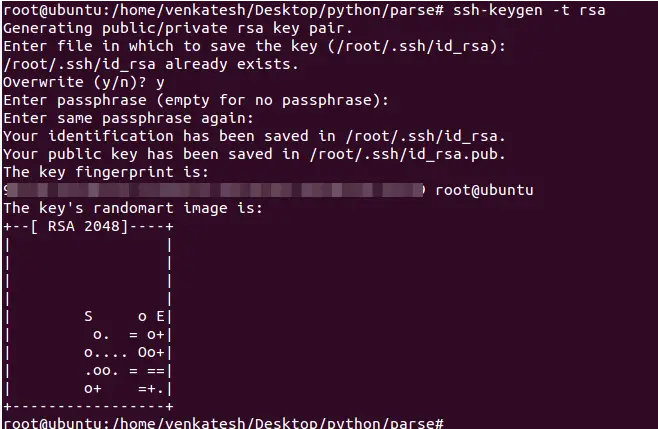
To generate the keys, from a terminal prompt enter:
This will generate the keys using the RSA Algorithm. During the process you will be prompted for a password. Simply hit Enter when prompted to create the key.
By default the public key is saved in the file ~/.ssh/id_rsa.pub, while ~/.ssh/id_rsa is the private key. Now copy the id_rsa.pub file to the remote host and append it to ~/.ssh/authorized_keys by entering:
Finally, double check the permissions on the authorized_keys file, only the authenticated user should have read and write permissions. If the permissions are not correct change them by:
You should now be able to SSH to the host without being prompted for a password.
Ubuntu Wiki SSH page.
Related
Introduction
You have seen in previous tutorials how to use PuTTY to connect to your VPS securely and how to create SSH keys with PuTTYgen.
You might have more than one SSH key for a single cloud server, or simply more than one cloud server or Droplet that requires SSH keys to log into. This can make you feel overwhelmed with having to manage, sort out, and link all those keys to their respective servers. That’s why Pageant exists.
Pageant is a PuTTY authentication agent. It holds your private keys in memory so that you can use them whenever you are connecting to a server. It eliminates the need to:
- Explicitly specify the relevant key to each Linux user account, if you use more than one account to log into a server
- Type a key’s passphrase each time you log into your user account; and your keys should be passphrase protected since having an unprotected key is as good as hiding your password under your keyboard!
Prerequisites
Make sure you have these prerequisites.
- Pageant is installed together with the PuTTY suite; if you don’t have it installed, you can download it here
- You should already have at least one SSH key saved on your local computer
Step 1 — Adding Keys to Pageant
Start Pageant from the PuTTY folder: Start-Menu > All Programs > PuTTY > Pageant
Pageant starts by default minimized in the system tray. To begin adding your SSH keys, you should right click on its icon and then the following context menu will show up:
Clicking on Add Key from the menu or View Keys to open up the Pageant Key List window. Here you can view, add, and remove keys:
Free steam key generator. As players gather weapons and loot from around the map, they start killing each other. To ensure players face off, a group forms on the map. Some decide to try major cities and immediately open fire on whoever they see. Some choose to hide in lone shacks or rush off to the wasteland.
Tip: You can access the Pageant Key List window directly by double-clicking its icon in the system tray.
Ubuntu Ssh Public Key No Password
Click the Add Key button. This will open the file explorer, where you can choose one or more keys at a time to load. You should select files with the .ppk extension:
Click the Open button to load the keys with Pageant.
If a key is passphrase-protected, you will be prompted to enter the passphrase only once before it can be added to the Pageant Key List:
After successfully adding a key, you can now see it listed:
Step 2 — Connecting to the Server(s)
Now these keys will be available while connecting to any server during your PuTTY sessions. You don’t have to take any extra steps in PuTTY. Just enter your hostname or IP address, and SSH user. PuTTY will automatically try to authenticate using any keys currently loaded in Pageant.
Step 3 (Optional) — Removing Keys from Pageant
If you want to remove a key from Pageant, select that key from the Pageant Key List window and press the Remove Key button. You can also remove multiple keys together by selecting them with CTRL or SHIFT.
Tips & Tricks
Use these tips to automate your authenticated connections with Pageant.
Loading Keys Automatically on Pageant Startup
You can make Pageant automatically load one or more private keys when it starts up, instead of adding them manually every time you start up Pageant.
Go to the Pageant shortcut icon from the Windows Start Menu or your desktop.
Right click on the icon, and click on Properties.
A new window will open containing the shortcut’s properties:
From the Shortcut tab, edit the Target field. Leave the path to pageant.exe intact. After that path, add paths to your .ppk key files. These should be outside the quotation marks. Here’s an example:
Click the Apply and then OK buttons.
Note: If the keys are encrypted, Pageant will request the passphrases on startup.
Generate Ssh Key Github
Making Pageant Run PuTTY
You can make Pageant start PuTTY or any other program once it has initialized itself and loaded any keys specified on its command line. That way you can just start Pageant instead of having to start both programs.
You can achieve this by following the same steps we used previously to add the keys automatically (see the previous section). Just add the program’s path at the end of the command in the Target field, preceded by the -c option, and contained within double quotes. Here’s an example of the full line for the Target field:
Other PuTTY Suite Products
Here are a few other helpful applications that can work with PuTTY.
- PuTTYgen: A tool to generate and edit SSH public and private key pairs. It is part of the PuTTY suite, but it can also operate with the private key formats used by some other SSH clients like WinSCP
- PSFTP: An interactive text-based client for the SSH-based SFTP (secure file transfer) protocol, that allows you to run an interactive file transfer session and perform many thing like listing the contents of directories, browsing around the file system, issuing multiple get and put commands, etc.
- PSCP (PuTTY Secure Copy Client): A tool for transferring files securely between computers using an SSH connection